A small business economy you can play right now
Small start. Big ambition.
Your first business is one click away: run your first sale or delivery and see exactly where the money came from. No account, no email, no tutorial video — you are in the game before you finish reading this.
Pick one of 10 trades in 4 families, then open all 46 businesses on the street.
Free to play. No card, no email address required.
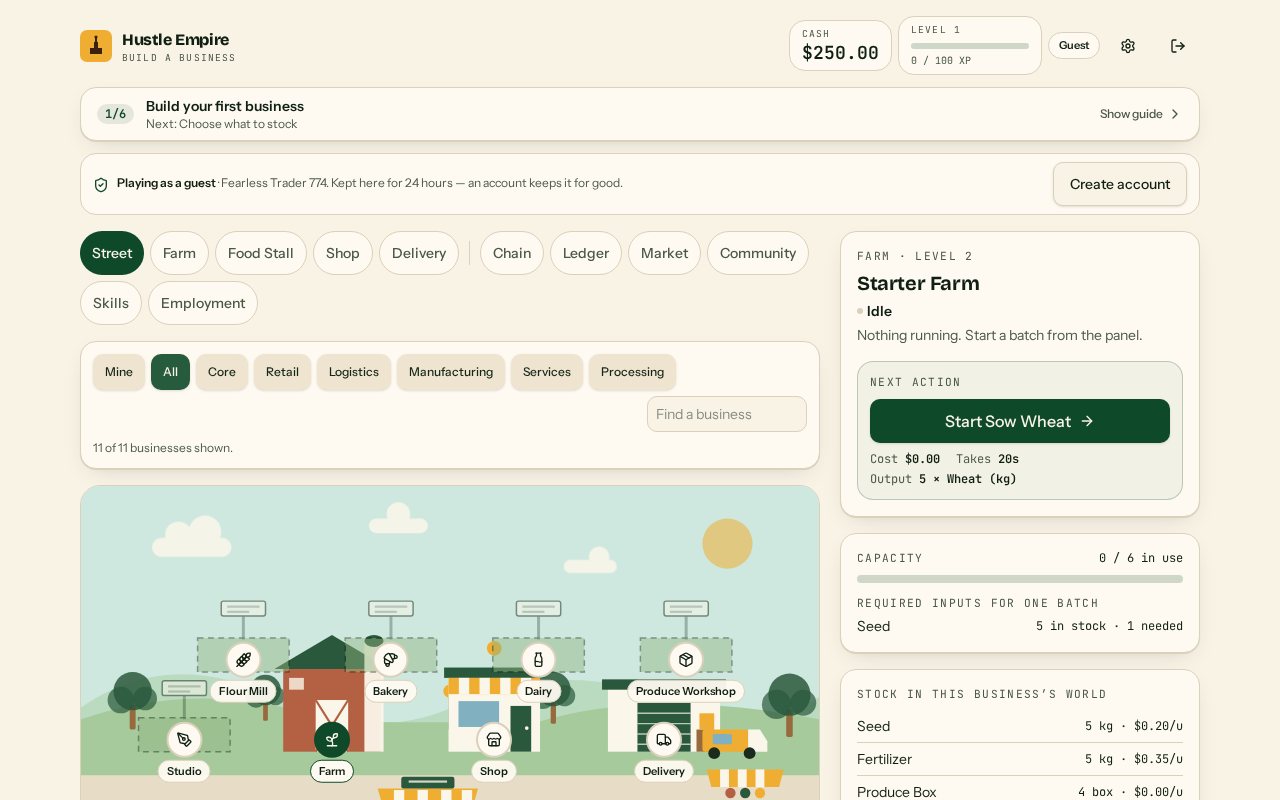
Your street: a farm, a food stall, a shop, a delivery depot, and the warehouse, workshop and studio you open next. Every building is playable, and every number comes from the server.
Look inside before you commit
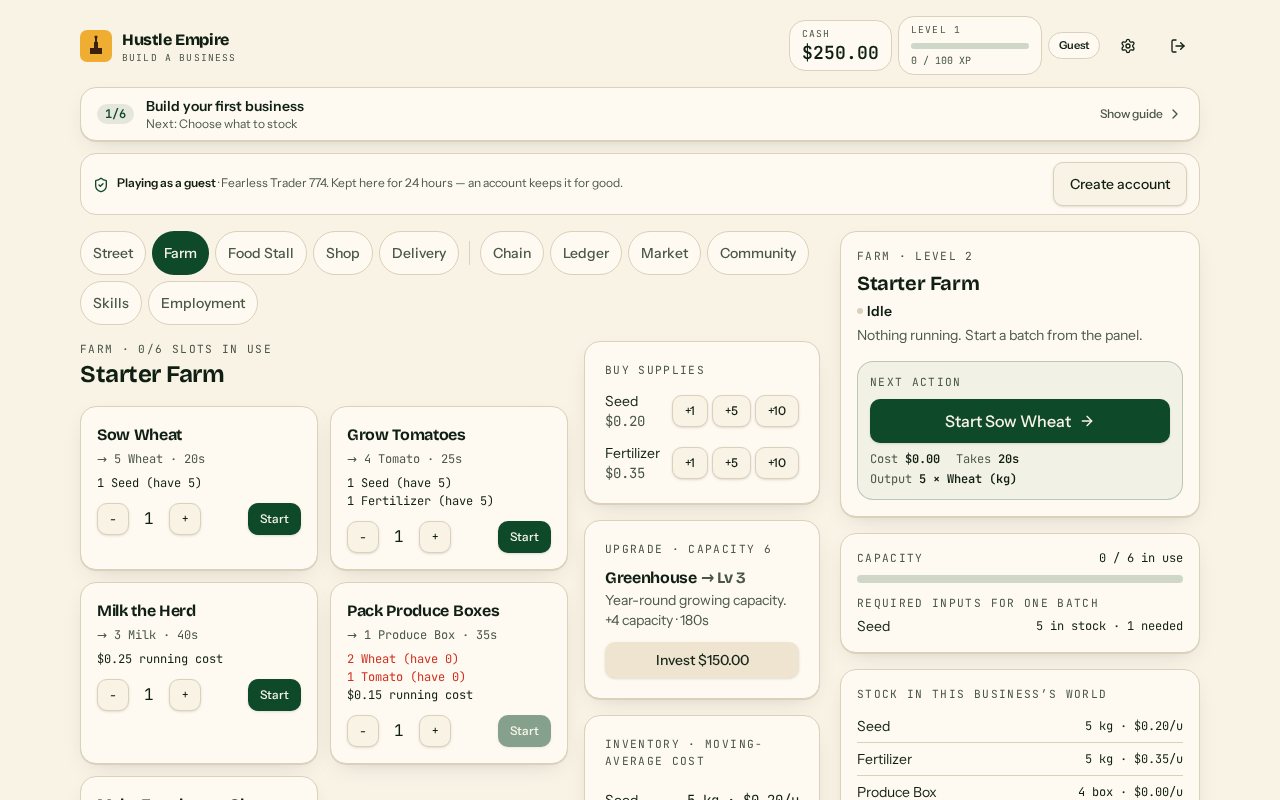
These are screens from the game itself: the street you run and the workspace where a batch becomes stock. No mock-ups, no rendered video.
Your first five minutes
- 1Get a starter business, a temporary name and the stock for your first sale.
- 2Choose your trade, then what to stock, produce or carry.
- 3Sell, deliver, and read the profit breakdown.
- 4Meet the suppliers and traders who can grow your business.
No strings
Play first. Sign up only if you like it.
A guest session is a real business on the real economy: real stock, real customers, real profit. It stays on our server for 24 hours, and creating an account moves it across instead of starting over.
Guest progress is stored on our server for 24 hours. Create a free account whenever you want to keep it for good.
One street, 46 businesses
Your farm feeds your stall, your stall stocks your shop, and your delivery route moves goods for other players. Shops sell finished goods only, so raw crops go to processing or to the player market once you have an account. Each business you run changes what the others can do — your chosen trade just decides where you start.
The first 4 are open on the first click. The rest are bought with cash you have earned, and each one changes what the others can do.
Farm
Turns seed and fertilizer into crops.
Food Stall
Cooks crops into finished meals.
Shop
Sells to a visible pool of customers.
Delivery
Fulfils contracts for premium pay.
Warehouse
Holds stock and buys wholesale on a standing order.
Workshop
Crafts timber into furniture worth selling.
Studio
Sells design work: no inputs, no shelf space.
Flour Mill
Mills wheat into flour for the bakery.
Bakery
Bakes flour into bread at a better margin than the stall.
Dairy
Churns milk into butter a shop can sell.
Produce Workshop
Cans tomatoes so they keep and travel.
Poultry Farm
Raises eggs and poultry on feed the mill can make.
Dairy Farm
Keeps a herd and sells milk to the dairy processor.
Fish Farm
Harvests fish from aerated ponds for the counter.
Farm Kitchen
Cooks the sector's eggs and milk into plates for the counter.
Café
Brews coffee and bakes pastries for a fast, small-ticket queue.
Restaurant
Turns raw ingredients into plated meals at a high ticket.
Catering Kitchen
Prepares trays for events: slow batches, few customers, large orders.
Grocery Shop
Stocks baskets from the produce wholesaler for the weekly shop.
Convenience Store
Sells snacks and drinks in a small, fast-refilling queue.
Clothing Shop
Sells garments: few customers, high tickets, price-sensitive.
Household Shop
Shows cookware and storage for the home on a slow, high-value queue.
Building Materials Shop
Makes and sells cement, roofing and paint: the yard every builder visits.
Produce Wholesaler
Grades farm crops into crates the grocery trade buys.
Food Distributor
Assembles flour, milk and eggs into food pallets for convenience stores.
General-goods Distributor
Packs textiles and metal into goods pallets for the equipment trade.
Cold Storage
Holds more stock and keeps two extra supplier orders running.
Haulage Operator
Runs heavier contracts than a courier and earns more per load.
Packaging Workshop
Cuts timber into the packaging every distributor and kitchen needs.
Garment Workshop
Sews bought textile into shirts and workwear for the clothing shop.
Household-goods Factory
Casts cookware and blows jars for the household shop.
Vehicle Repair Garage
Services vehicles from spare parts and coolant.
Equipment Workshop
Builds equipment kits from goods pallets and metal.
Refrigeration Repair
Services cold rooms with coolant and spare parts.
Solar Installation
Installs panels for customers: a high-ticket service, not a utility bill.
Equipment Rental
Hires plant out by the day, fuelled and maintained per booking.
Water Treatment
Treats and bottles water for a steady daily queue.
Construction Company
Raises buildings from cement, roofing and timber.
Fit-out Workshop
Builds shop fit-outs from timber and paint for the construction trade.
Property Maintenance
Carries out repair visits for owners and shops.
Bookkeeping Practice
Keeps clients' books on a monthly retainer.
Marketing Agency
Runs campaigns for local businesses, paid per package.
Business Software
Ships software releases and sells licences by the seat.
Collection Service
Collects recyclables from the street for the recycling workshop.
Recycling Workshop
Sorts scrap into recycled metal and compost.
Reusable Packaging
Turns recycled metal into crates the grocery chain reuses.
The systems behind the counter
A sale is the visible part. Six systems decide what the sale costs, what it pays and what you can do next. The player market and community projects open when you create a free account; everything else works from the first click.
Skills that change the numbers
13 skills across 6 disciplines cut batch time, raise output and lower fees.
Standing supplier orders
Up to 3 contracts restock your inputs on a timer, cheaper than buying at spot prices.
Upgrades and storage
Every business level adds capacity; warehouses raise how much stock you can hold.
Player market
List surplus for other players in escrow, with a fee that falls as market analysis grows.
Courier work
Move other players' goods: route distance, deadlines and trader ratings decide the pay.
Community projects
Pool cash with other players to fund shared projects for the whole street.
Questions people ask before their first sale
Do I need an account?
No. A guest session is a real business on the real economy — stock, customers and profit. It is kept for 24 hours, and creating a free account moves it across instead of starting over.
What does it cost?
Nothing to play, and there is no pay-to-win: prices, demand and payouts are the same for every player. Anything optional that is ever sold — appearance, recognition, extra challenge scenarios — sits outside the economy and is never a condition of playing.
How long until my first sale?
A starter trade arrives with stock for one sale, so the first one takes a minute. The batches behind it run from 20 seconds to 2 minutes 30 seconds, and the game keeps working while the tab is closed.
Can I lose progress?
A guest business expires with its 24-hour session. An account keeps everything permanently and can export or delete its data at any time.
Is this a single-player game?
The market, courier contracts and community projects are shared with other players. The server settles every action, so a sale, a delivery or a listing cannot be faked from the browser.
What do I need to run it?
A browser. It is designed for a phone first and works with a keyboard and a screen reader.
Playing with other people
Player trading and shared projects open up when you create a free account, so the economy stays fair for everyone.